
Managing Agents
Agents are the AI personalities that power your Selu assistant. You can install them from the marketplace, configure their models and permissions, and keep them updated.
Installing Agents
Section titled “Installing Agents”From the Marketplace
Section titled “From the Marketplace”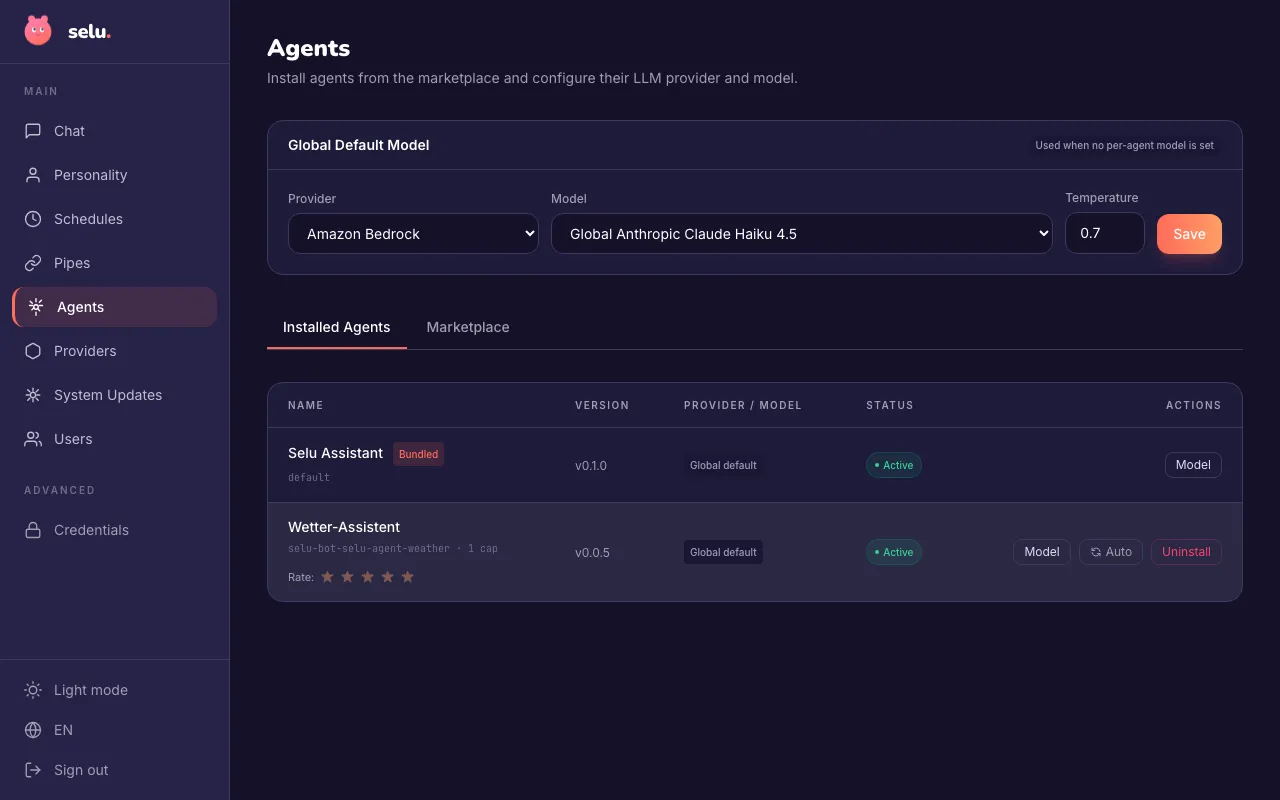
-
Go to Agents in the sidebar
-
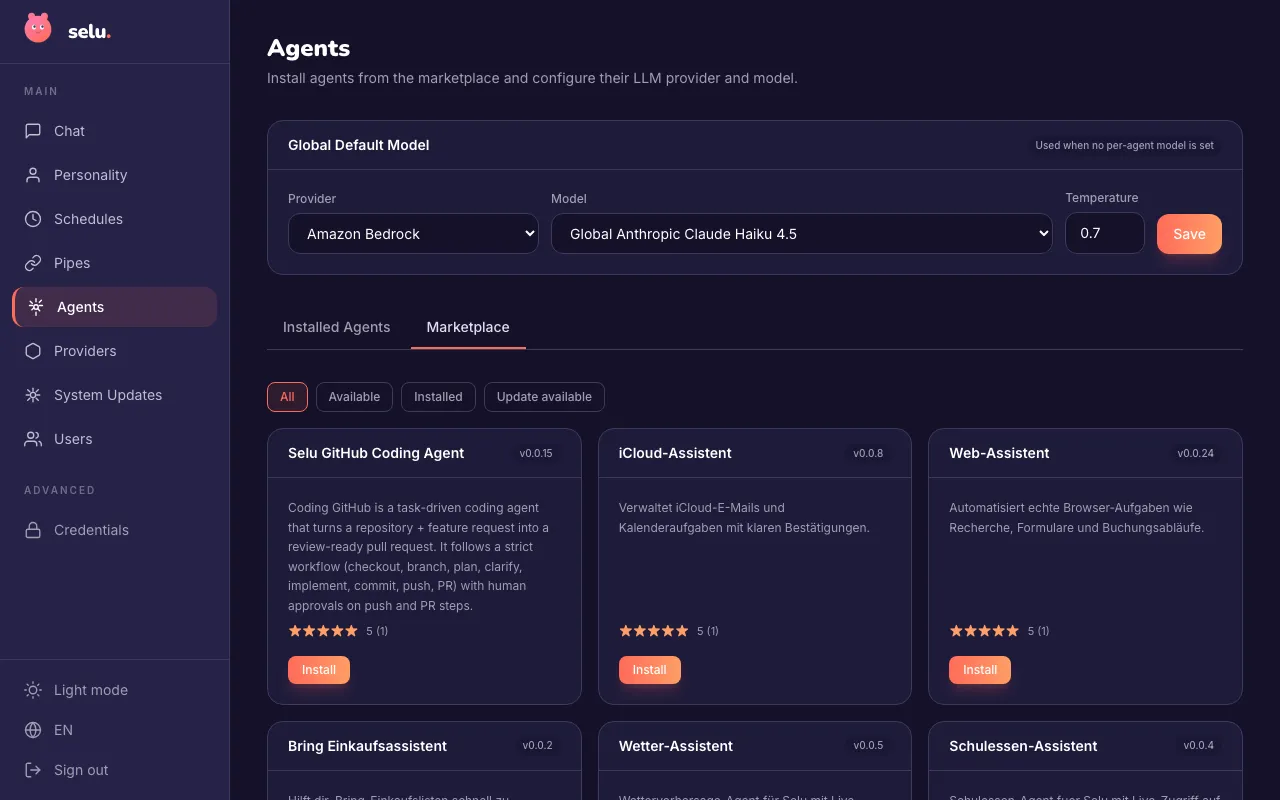
Click the Marketplace tab
-
Browse available agents or use the filter buttons:
- All — Show every agent
- Available — Only uninstalled agents
- Installed — Only agents you have
- Update available — Agents with newer versions
-
Click Install on any agent you want
Setup Wizard
Section titled “Setup Wizard”After installation, most agents need setup:
- Configuration — Enter API keys or other settings the agent needs
- Tool Permissions — Choose how the agent can use its tools:
- Allow — Use freely without asking
- Ask — Request permission each time
- Block — Never allow
- Model Assignment — Pick which LLM provider and model this agent uses
Agent Behavior
Section titled “Agent Behavior”Session Management
Section titled “Session Management”Agents handle conversations differently based on their session settings:
Shared Sessions (Default)
Section titled “Shared Sessions (Default)”Most agents use shared sessions, which means:
- Multiple conversation threads with the same agent share the same container
- Capabilities and workspace data persist across threads
- More efficient resource usage
- Good for stateless agents like weather or search assistants
Per-Thread Isolation
Section titled “Per-Thread Isolation”Some specialized agents use per-thread isolation:
- Each conversation thread gets its own dedicated containers
- Workspace data is completely isolated between threads
- Uses more resources but prevents interference
- Essential for coding agents or workspace managers
Complex Task Steps
Section titled “Complex Task Steps”Each agent has a configurable limit on how many tool-call steps it can perform in a single turn. This prevents runaway loops while allowing complex multi-step workflows:
- Default limit: 32 steps per turn
- Per-user control: You can set custom limits for each agent on your account
- Unlimited option: Set to 0 to remove the limit entirely
- Administrative defaults: Admins can set system-wide defaults
This setting is useful for:
- Coding agents that need many steps to complete complex tasks
- Search agents that might follow multiple research paths
- Administrative agents performing batch operations
You can adjust this on the agent’s Overview tab under “Complex Task Steps.”
Updating Agents
Section titled “Updating Agents”Background Updates with Progress
Section titled “Background Updates with Progress”Agent updates now run seamlessly in the background with live progress tracking:
- Click Update next to any agent with an available update
- Review the update information in the confirmation modal
- Click Confirm Update to start the background process
- Watch the real-time progress card that appears at the top of the page
- The progress shows actual Docker image download progress
- When complete, you’ll see either a success notification or be redirected to setup if new permissions are needed
The new update wizard ensures you only go through setup when the agent actually needs new permissions or credentials — routine updates complete automatically.
Auto-Updates
Section titled “Auto-Updates”Enable auto-updates for hands-free maintenance:
- Find the Auto toggle button next to any installed agent
- Click to enable (green) or disable (gray)
- Selu will automatically update these agents when newer versions are released
Configuring Agents
Section titled “Configuring Agents”Model Assignment
Section titled “Model Assignment”Each agent can use a different LLM provider and model:
- Go to the Agents page
- Click Model next to any agent
- Choose a provider and model from the dropdown
- Set the temperature (0.0 = focused, 1.0 = creative)
- Click Save
Leave provider blank to use the global default model.
Agent Detail Pages
Section titled “Agent Detail Pages”Click any agent name to see detailed information organized into focused tabs:
Overview Tab
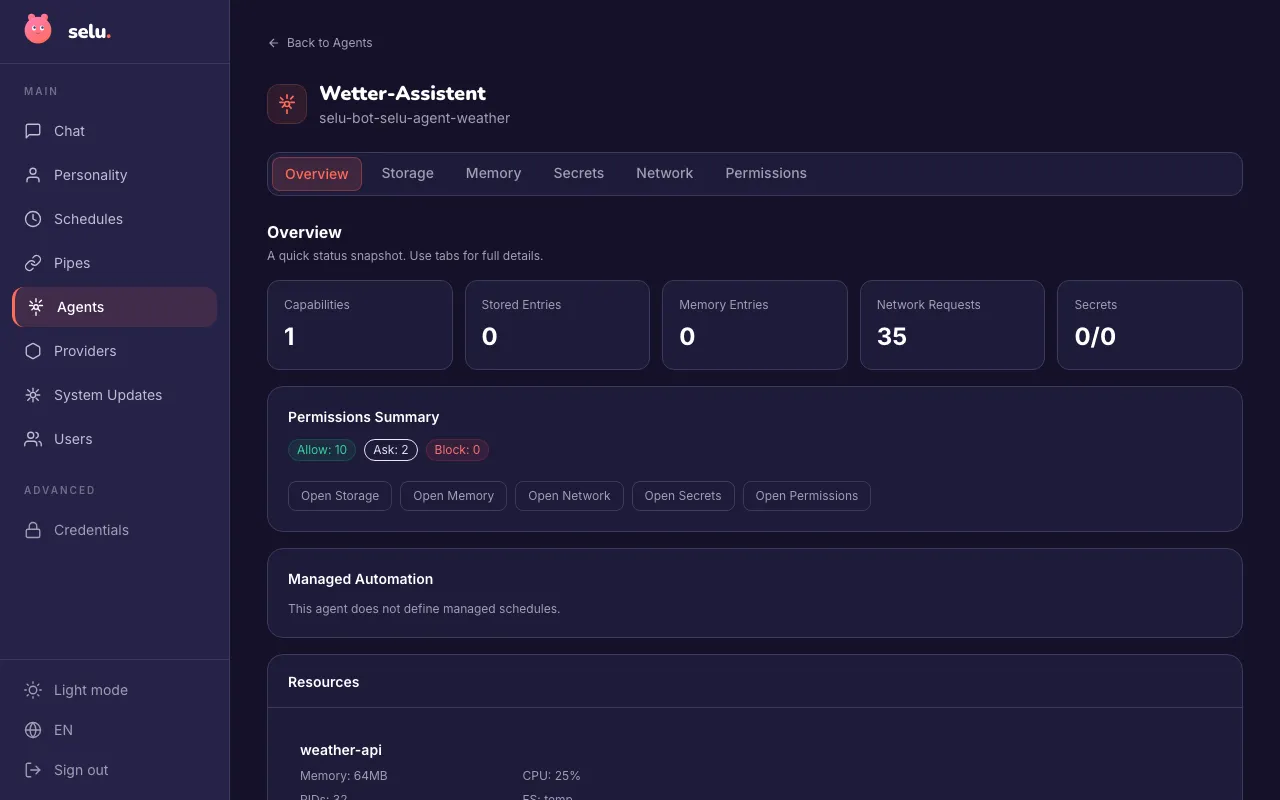
Section titled “Overview Tab”The Overview tab gives you a quick status snapshot with key metrics:
- Capabilities — Number of tools/services this agent uses
- Stored Entries — How much persistent data the agent has saved
- Memory Entries — Long-term contextual notes the agent has saved
- Network Requests — Total outbound API calls made
- Secrets — Credential status (how many are set vs. missing)
You’ll also see:
- Permissions Summary — Count of Allow/Ask/Block permissions
- Resource Usage — Memory, CPU, and process limits per capability
- Complex Task Steps — Current tool-loop iteration limit for this agent
- Quick Links — Jump directly to Storage, Memory, Secrets, Network, or Permissions tabs
Storage Tab
Section titled “Storage Tab”View and manage the persistent data your agent has saved:
- See all key-value pairs the agent stored using
store_set - View timestamps showing when each entry was last updated
- Delete individual entries you no longer need
- Admins can see data from all users; regular users see only their own
Memory Tab
Section titled “Memory Tab”Inspect the agent’s long-term memory notes:
- View contextual information the agent has remembered using
memory_remember - See tags and source information for each memory entry
- Delete memories that are no longer relevant
- View when each memory was last updated
- Admins can see memories from all users; regular users see only their own
Network Tab
Section titled “Network Tab”Monitor and control your agent’s external connectivity with granular per-capability controls:
Network Access Control
Section titled “Network Access Control”For each capability, you can override the agent’s default network behavior:
- Allow — Let this capability access the network (respects host allowlists)
- Deny — Block all network access for this capability
Your choice here overrides the agent’s default network setting for your account only.
Host-Level Controls
Section titled “Host-Level Controls”For capabilities with allowlist-based networking, you can control access to specific hosts:
Default Hosts
Section titled “Default Hosts”These come from the agent’s configuration:
- Set any default host to Deny to block access to that specific service
- Keep as Allow to permit access as the agent author intended
Custom Hosts
Section titled “Custom Hosts”Add your own host rules for additional control:
- Enter a host (like
pypi.org:443orapi.example.com) - Click Add to create a custom allow rule
- Toggle between Allow and Deny for any custom host
- Click Remove to delete custom entries you no longer need
Network Activity Log
Section titled “Network Activity Log”View the last 100 network requests to monitor agent behavior:
- Timestamps — When each request was made
- Method & Host — What endpoint was accessed (GET, POST, etc.)
- Port — Which port was used (443 for HTTPS, 80 for HTTP, etc.)
- Status — Whether the request was Allowed or Denied
- Capability — Which tool made the request
This helps you debug connectivity issues and understand what external services your agents are using.
Secrets Tab
Section titled “Secrets Tab”Manage credentials and API keys that your agent needs to access external services:
- Each capability shows its declared secrets with descriptions
- See which secrets are Required vs Optional
- Check if secrets are Shared (system-wide) or Personal (per-user)
- Enter credential values directly in the form fields
- Click Save to store them securely (encrypted with AES-256-GCM)
Each secret shows:
- Description — What the credential is for and where to get it
- Status — Whether it’s currently set or missing
- Timestamp — When it was last updated
Permissions Tab
Section titled “Permissions Tab”Configure tool access controls:
- Set global defaults (admins only)
- Create personal overrides for your account
- Manage both capability tools and built-in tools
- See which permissions you’ve customized
All agents have access to these built-in tools:
- Delegate to Agent — Hand off tasks to other specialist agents
- Store Get/Set/Delete/List — Persistently store key-value data between conversations
- Memory Remember/Forget/Search/List — Save and retrieve long-term memory notes
- Set Reminder — Schedule one-time future actions
- Set Schedule — Create recurring automated tasks
These tools follow the same permission system as capability tools.
Managed Automation
Section titled “Managed Automation”Some agents support managed automation — pre-configured schedules that the agent author has designed for common use cases.
Enabling Automation
Section titled “Enabling Automation”If an agent supports automation, you’ll see a Managed Automation panel on its Overview tab:
- Click on any agent name to open its detail page
- Look for the Managed Automation section
- Review the automation requirements:
- At least one active pipe must use this agent as default
- All required credentials for the agent must be set
- Click Enable automation if all requirements are met
How It Works
Section titled “How It Works”When you enable automation:
- Selu creates the agent’s predefined schedules automatically
- All schedules are pinned to that specific agent
- The schedules run on your active pipes at the configured times
- Results appear as new conversations in your chat interface
Disabling Automation
Section titled “Disabling Automation”To turn off managed automation:
- Go to the agent’s detail page
- Find the Managed Automation panel
- Click Disable automation
This turns off all managed schedules but doesn’t delete them — you can re-enable later.
Agent Storage & Memory
Section titled “Agent Storage & Memory”Agents can persistently store information in two ways:
Storage (Key-Value Data)
Section titled “Storage (Key-Value Data)”Agents use built-in storage tools for structured data that survives container restarts:
- Sync checkpoints — Remember where they left off with external services
- User preferences — Store your settings and configuration
- Bookmarks — Keep track of important URLs or resources
- State management — Maintain context across long-running tasks
View stored data on the Storage tab of any agent’s detail page.
Memory (Long-term Notes)
Section titled “Memory (Long-term Notes)”Agents can save and search contextual memories using BM25 relevance:
- Conversation insights — Remember important facts from past discussions
- User context — Build understanding of your preferences over time
- Project history — Track progress on ongoing work
- Learning — Accumulate knowledge from interactions
View memory entries on the Memory tab of any agent’s detail page.
Schedules and Reminders
Section titled “Schedules and Reminders”Agents can help you create automated schedules and reminders, and these are now intelligently handled to ensure consistency:
Agent Pinning
Section titled “Agent Pinning”When an agent creates a schedule or reminder using the built-in tools, that schedule is pinned to that agent. This means:
- The same agent that created the schedule will always execute it
- Even if you change your pipe’s default agent later, pinned schedules keep using their original agent
- This prevents automation workflows from drifting to different agents over time
One-time Reminders
Section titled “One-time Reminders”When you ask an agent to remind you of something, it can use the set_reminder tool:
"Remind me to check the weather next Sunday morning""Set a reminder to call the dentist tomorrow at 3pm"The agent will:
- Parse the timing you specified
- Convert it to your timezone
- Schedule the reminder to fire at the right time
- Execute the task when the time comes (using the same agent)
Timezone Handling
Section titled “Timezone Handling”Agents handle timezone conversion intelligently when creating reminders:
- Times you specify without timezone info are interpreted in your configured timezone
- Times with explicit timezone/offset are used exactly as specified
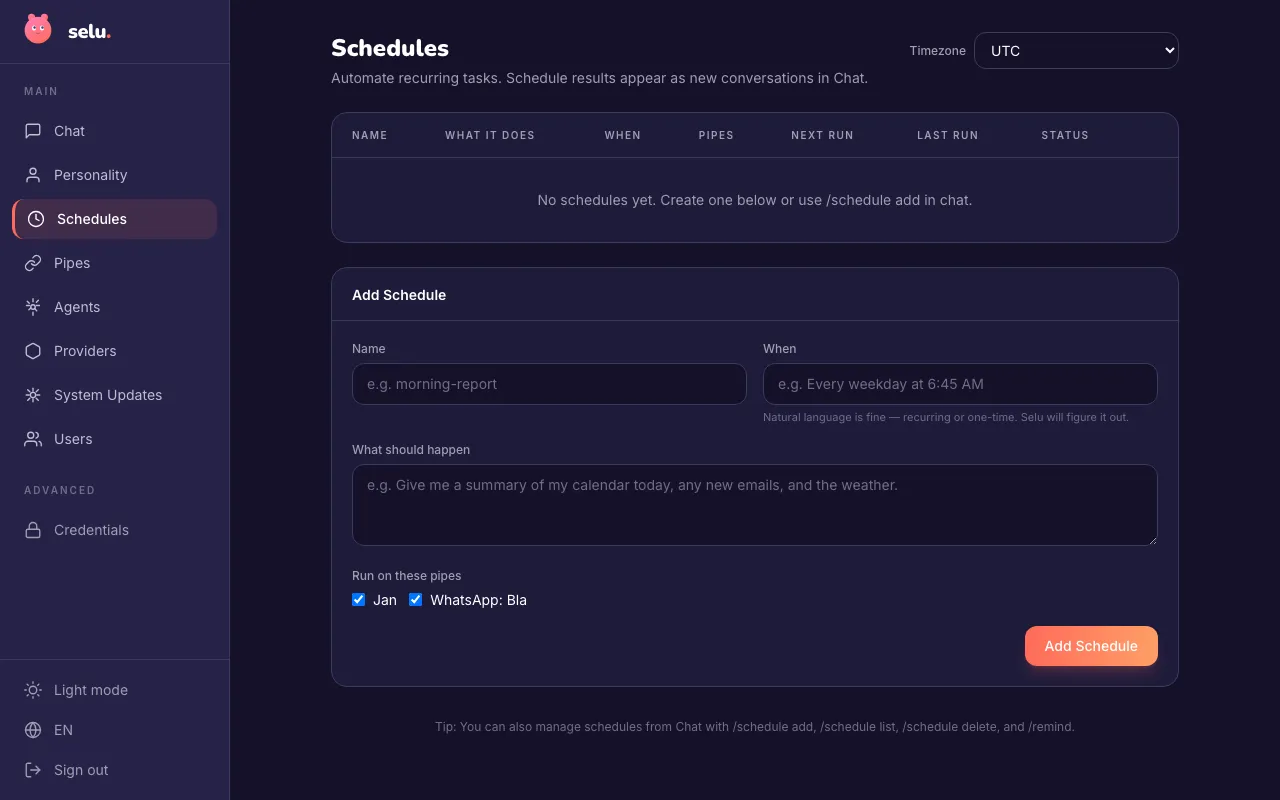
- Your timezone can be updated on the Schedules page
This means if you’re in Berlin and say “remind me at 3pm tomorrow,” the agent creates a reminder for 3pm Berlin time.
Recurring Schedules
Section titled “Recurring Schedules”For repeated tasks, agents can use the set_schedule tool or guide you to use the /schedule command:
"Check my calendar and weather every weekday at 6:45 AM""Send me a weekly summary every Friday afternoon"You can also use the /schedule command directly or manage schedules from the Schedules page.
Both reminders and schedules appear on the Schedules page where you can manage them.
Global Settings
Section titled “Global Settings”Default Model
Section titled “Default Model”Set a fallback model for all agents:
- Go to the Agents page
- Find Global Default Model at the top
- Choose a provider, model, and temperature
- Click Save
This model is used when individual agents don’t have specific assignments.
Troubleshooting
Section titled “Troubleshooting”Agent Won’t Start
Section titled “Agent Won’t Start”- Check that all required secrets are set on the Secrets tab
- Verify the agent completed setup successfully
- Look at the Network tab for blocked requests
Update Failed
Section titled “Update Failed”- Ensure Docker is running and accessible
- Check your internet connection
- Try the update again — progress resumes from where it left off
Tools Not Working
Section titled “Tools Not Working”- Check tool permissions on the Permissions tab
- Verify any required API keys are configured on the Secrets tab
- Look for “Ask” permissions that might need approval
Network Issues
Section titled “Network Issues”- Check the Network tab for denied requests in the activity log
- Verify that network access is set to Allow for the capability having trouble
- Add custom host entries if the agent needs access to services not in its default allowlist
- Check if any default hosts have been set to Deny that the agent actually needs
Memory Issues
Section titled “Memory Issues”- Check the Memory tab to see what the agent has stored
- Verify the agent has permission to use memory tools
- Delete old memories if you want the agent to “forget” something
- Memory retrieval is automatic — agents will find relevant notes during conversations
Conversations Interfering With Each Other
Section titled “Conversations Interfering With Each Other”Some agents (like coding assistants) use per-thread isolation to prevent this:
- Check the agent’s session mode on the Overview tab
- Each conversation thread gets its own isolated workspace
- If you need isolation for an agent that doesn’t have it, contact support
Storage Issues
Section titled “Storage Issues”- Check the Storage tab to see what data the agent has saved
- Delete old entries if storage seems corrupted
- Admins can view all user data to diagnose cross-user issues
Automation Not Available
Section titled “Automation Not Available”- Check if the agent declares automation support (not all agents do)
- Ensure you have at least one active pipe using this agent as default
- Verify all required credentials are set before enabling
Schedules Not Executing Correctly
Section titled “Schedules Not Executing Correctly”- Remember that agent-created schedules are pinned to the creating agent
- Check the Schedules page to see which agent owns each schedule
- Verify the pinned agent has all necessary permissions and credentials
- If you want to change which agent executes a schedule, delete and recreate it with the desired agent
Reminders Not Firing
Section titled “Reminders Not Firing”- Check the Schedules page to see if your reminder was created
- Verify your timezone is set correctly on the Schedules page
- Ensure the agent has Allow permission for the
set_remindertool - Ensure the reminder time was set for the future (past times are ignored)
Complex Tasks Hitting Step Limit
Section titled “Complex Tasks Hitting Step Limit”If your agent stops mid-task with a “tool loop exceeded iterations” error:
- Check the Complex Task Steps setting on the agent’s Overview tab
- Increase the limit if you need more steps for complex workflows
- Set to 0 for unlimited steps (use with caution)
- Consider breaking complex requests into smaller parts
Agent Updates Requiring Unnecessary Setup
Section titled “Agent Updates Requiring Unnecessary Setup”The new update wizard should only prompt for setup when truly needed. If you’re repeatedly asked to configure things that haven’t changed:
- Check that your global tool policies are properly set (admins only)
- Verify that system-scoped credentials are saved at the system level
- Try the update again — the wizard learns from existing configurations