
System Updates
Selu includes a built-in update system that can automatically keep your installation current with the latest releases. Updates are managed through a dedicated sidecar container and can be monitored through the web interface.
Update Channels
Section titled “Update Channels”Selu offers different release channels to match your stability preferences:
Recommended for production use. Thoroughly tested releases with full documentation. Updates are less frequent but highly reliable.
Pre-release versions with the latest features. More frequent updates with good stability, suitable for testing new functionality.
Daily builds from the main development branch. Cutting-edge features but may have bugs. Only recommended for development environments.
Accessing System Updates
Section titled “Accessing System Updates”- Log in to your Selu instance as an administrator
- Navigate to System Updates in the sidebar
- You’ll see your current version, available updates, and update settings
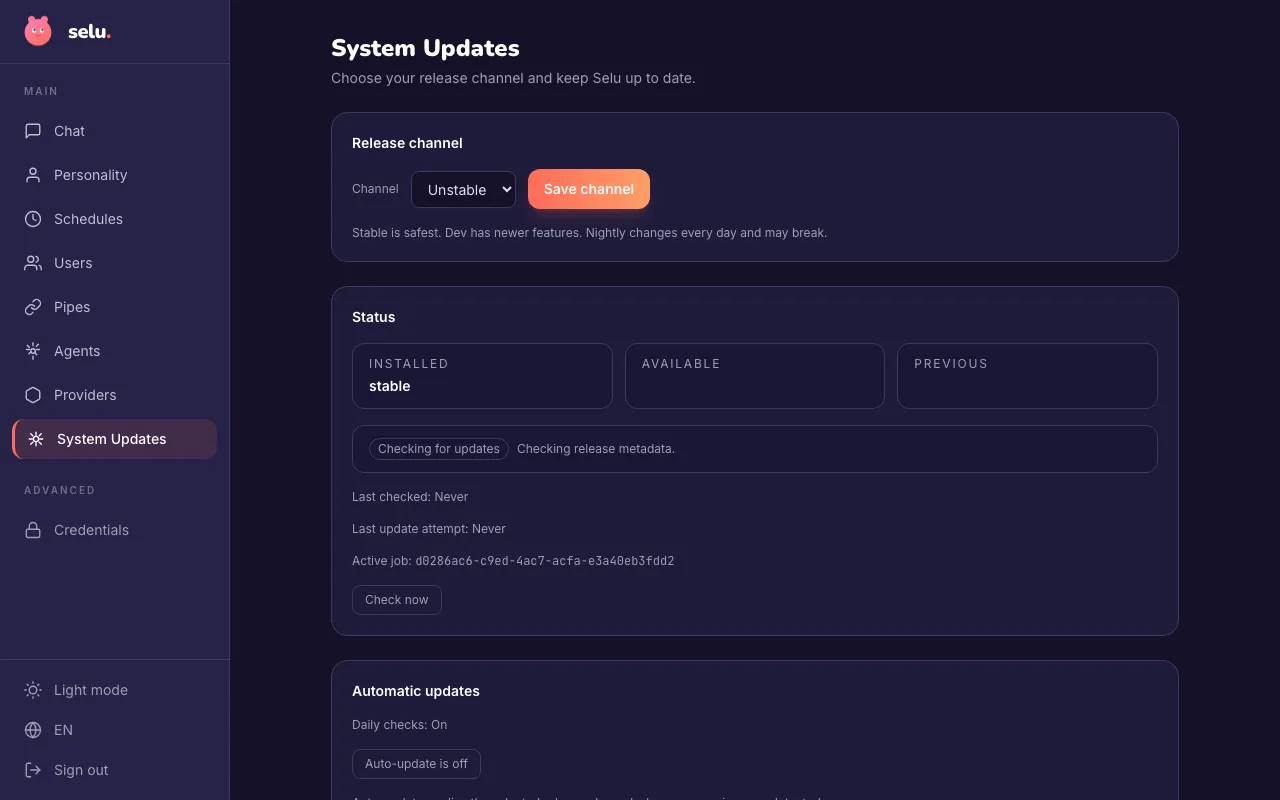
Manual Updates
Section titled “Manual Updates”Background Update Process
Section titled “Background Update Process”Updates now run seamlessly in the background with live progress tracking:
- Click Check now to search for new releases
- If updates are available, click Update now
- Confirm the update in the modal dialog
- Watch the live progress card showing:
- Current update stage
- Docker image download progress
- Real-time status updates
- The page automatically reloads when the update completes
The update system continues running even while Selu restarts, ensuring reliable completion.
Update Progress Stages
Section titled “Update Progress Stages”During an update, you’ll see progress through these stages:
- Checking — Verifying available releases
- Downloading — Pulling new Docker images
- Applying — Updating containers and configuration
- Restarting — Bringing up the new version
- Complete — Update finished successfully
Automatic Updates
Section titled “Automatic Updates”Enable automatic updates for hands-free maintenance:
- Go to System Updates
- Toggle Auto-update to enabled
- Choose your preferred update channel
- Selu will automatically apply updates when they become available
Update Configuration
Section titled “Update Configuration”Release Channel
Section titled “Release Channel”Change your release channel to control which updates you receive:
- Select your preferred channel from the dropdown
- Click Save to apply the change
- The next update check will look for releases on the new channel
Changing channels takes effect immediately and will be saved to your Docker Compose environment file.
Public Web Address
Section titled “Public Web Address”Set Selu’s public URL for external integrations:
- Enter your public URL in the Public Web Address field (e.g.,
https://selu.example.com) - Or click Use current to auto-detect from your browser
- Click Save to store the setting
This URL is used for:
- Webhook registration with external services
- Generated download links for file attachments
- Callback URLs for OAuth integrations
The public address is stored in the database and takes effect immediately without restart.
Anonymous Installation Statistics
Section titled “Anonymous Installation Statistics”Selu can send a daily anonymous heartbeat to selu.bot to help show installation popularity and marketplace activity.
What’s sent
Section titled “What’s sent”- Installation ID: A random, persistent ID created once per Selu installation
- Selu version: The currently installed version
- Installed marketplace agent IDs: To count active usage per marketplace agent
- Installed marketplace agent versions: To track adoption per agent version
Nothing else is included in this telemetry. Selu does not send chats, prompts, usernames, IP addresses, or credentials.
Why this helps
Section titled “Why this helps”- Show how many active Selu installations exist
- Show what share of installations is on the latest release
- Show active users per marketplace agent
How to opt out
Section titled “How to opt out”In the System Updates page, turn off Anonymous installation statistics. When disabled, Selu stops sending telemetry heartbeats entirely.
Rollback
Section titled “Rollback”If an update causes issues, you can rollback to the previous version:
- Go to System Updates
- Click Rollback when available
- Confirm the rollback in the modal dialog
- Monitor the progress as Selu reverts to the previous release
Update Architecture
Section titled “Update Architecture”Sidecar Updater
Section titled “Sidecar Updater”Selu uses a separate updater container to manage system updates:
- Isolation — Updates run independently of the main application
- Reliability — Updates continue even if the main container restarts
- Safety — Automatic rollback if health checks fail after update
- Progress tracking — Real-time feedback during update operations
Health Checks
Section titled “Health Checks”After each update, Selu performs health checks to ensure the new version is working correctly:
- Database connectivity
- Core service availability
- Configuration validation
- Docker daemon access
If health checks fail, the system automatically rolls back to the previous version.
Troubleshooting
Section titled “Troubleshooting”Update Stuck or Failed
Section titled “Update Stuck or Failed”If an update appears stuck or fails:
- Check the progress modal for specific error messages
- Ensure Docker is running:
docker ps - Verify internet connectivity for downloading images
- Try the update again — progress resumes from where it left off
- If persistent issues occur, check Docker logs:
docker logs selu-updater
Auto-Update Not Working
Section titled “Auto-Update Not Working”If automatic updates aren’t occurring:
- Verify Auto-update is enabled in System Updates
- Check that your release channel is correctly set
- Ensure the updater container is running:
docker ps | grep updater - Review updater logs:
docker logs selu-updater
Rollback Not Available
Section titled “Rollback Not Available”If the rollback option isn’t showing:
- Confirm you’ve performed at least one successful update
- Check that the rollback window hasn’t expired
- Verify the previous version information is available in System Updates
- Try refreshing the System Updates page
Public Address Issues
Section titled “Public Address Issues”If external integrations aren’t working after setting a public address:
- Ensure the URL is accessible from the internet (for webhooks)
- Verify HTTPS is properly configured if using SSL
- Check that the URL format is correct (include
https://orhttp://) - Test the address by accessing it from an external network
Version Mismatch After Update
Section titled “Version Mismatch After Update”If the version shown doesn’t match what you expected:
- Hard refresh the browser page (Ctrl+F5 / Cmd+Shift+R)
- Clear browser cache if the interface seems outdated
- Check Docker images:
docker images | grep selu - Verify the update completed successfully in System Updates
Security Considerations
Section titled “Security Considerations”Update Verification
Section titled “Update Verification”Selu verifies all updates using:
- Release signatures — Cryptographic verification of release metadata
- Image digests — SHA-256 verification of Docker images
- Channel validation — Ensures updates come from official release channels
Network Requirements
Section titled “Network Requirements”Updates require outbound internet access to:
https://selu.bot/api/releases/selu— Release metadata- Docker registries (typically
ghcr.io) — Container images
Ensure these domains are accessible from your Selu instance.
Backup Recommendations
Section titled “Backup Recommendations”While Selu includes automatic rollback, consider regular backups:
- Database — Export your SQLite database regularly
- Configuration — Back up your
.envfile anddocker-compose.yml - Agent data — Back up the
installed_agentsdirectory - Persistent data — Back up the
datadirectory containing user information
Manual Update Alternative
Section titled “Manual Update Alternative”If you prefer to manage updates manually via Docker Compose:
- Disable auto-update in the web interface
- Update your
docker-compose.ymlwith the desired image tag - Run
docker-compose pull && docker-compose up -d - Monitor the application health after the update