
Web Chat
Selu ships with a built-in web chat interface. It’s the fastest way to start talking to your agents — no extra apps or accounts needed.
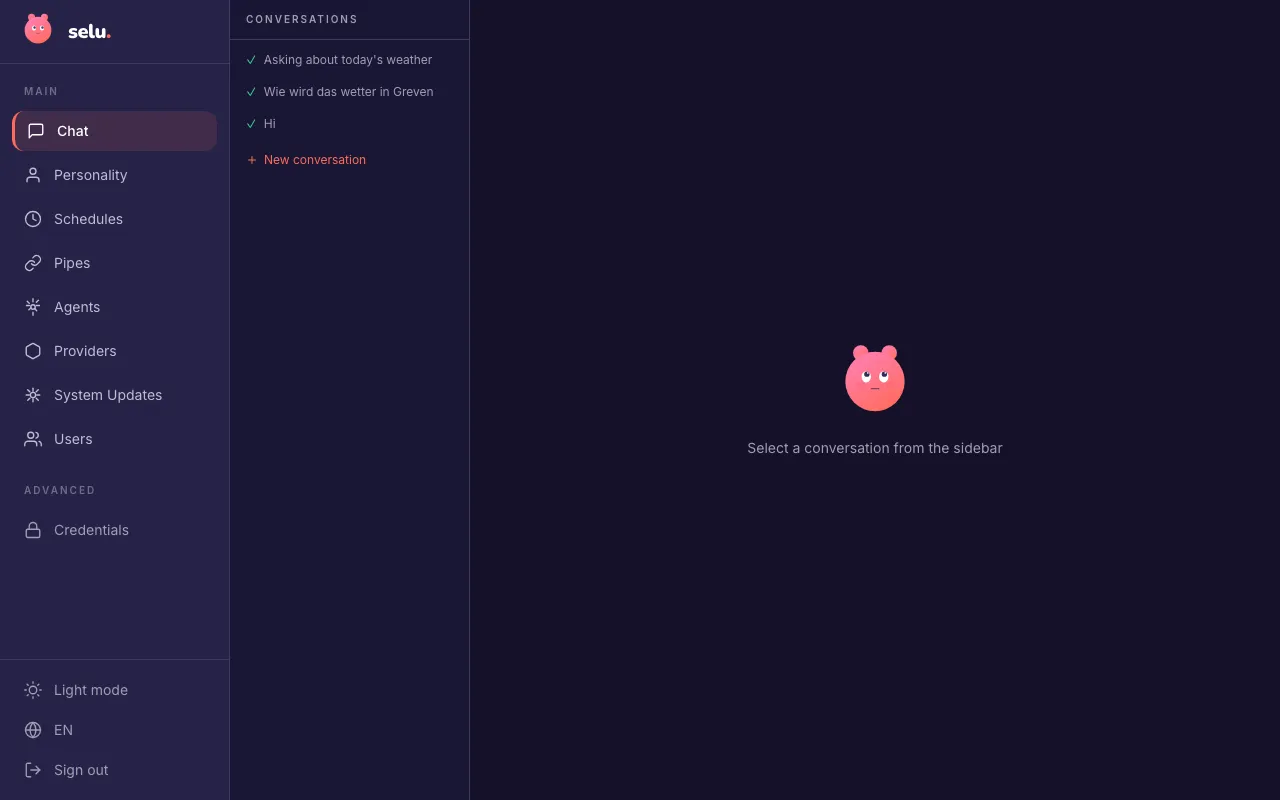
Accessing web chat
Section titled “Accessing web chat”Once Selu is running, open your browser and navigate to your Selu instance:
http://localhost:3000If you’ve configured a custom domain or port, use that address instead. The chat interface loads automatically and connects to your default agent.
Features
Section titled “Features”The web chat interface includes:
- Real-time streaming — Responses appear as the agent generates them, so you don’t have to wait for a full reply.
- Conversation history — Your recent conversations are saved and organized by pipe.
- Multi-pipe support — Switch between different ways to talk to your agents (web, Telegram, iMessage, etc.).
- Mobile friendly — The interface adapts to phones and tablets with a slide-in conversation drawer.
- Slash commands — Use special commands starting with
/for quick actions. - Interactive approvals — When agents need permission to use tools, you get inline approve/deny buttons.
- Thread management — Organize conversations into separate threads for better context.
Smart timezone handling
Section titled “Smart timezone handling”Selu automatically provides agents with date and time context in your configured timezone. When you mention relative dates like “tomorrow” or “next Friday,” your agent understands them correctly based on your local time, not server time.
The system includes explicit anchors for:
- Current date and time in your timezone
- Today’s date
- Tomorrow’s date
- Yesterday’s date
This ensures accurate scheduling and date-based requests across all time zones. You can update your timezone setting on the Schedules page.
Interactive tool approvals
Section titled “Interactive tool approvals”When you have tool policies set to Ask, web chat provides the smoothest approval experience:
- The agent pauses and shows: “I want to use [tool name]. Approve this action?”
- You see Approve and Deny buttons right in the chat
- Click your choice and the agent immediately continues or adapts
This is faster than the approval flow in messaging channels like Telegram or iMessage, where you need to send a reply message.
Sending images
Section titled “Sending images”You can attach images to your messages in web chat. Selu automatically handles sizing before sending them to the AI model:
- Images that are within the model’s size limit are sent as-is.
- Oversized images are downscaled and recompressed automatically so the conversation doesn’t fail.
- If an image is too large to compress down to fit, it’ll be skipped — the agent will let you know and you can try a smaller version.
Mobile interface
Section titled “Mobile interface”On mobile devices, the chat interface adapts for smaller screens:
- Slide-in drawer — Access conversation threads via a chat bubble icon in the top bar.
- Thread selection — When a pipe is selected but no thread is active, tap “Open conversations” to see available threads.
- Auto-dismiss — The thread drawer closes automatically when you select a conversation.
- Close controls — Use the × button or tap the backdrop to manually close the drawer.
Slash commands
Section titled “Slash commands”Web chat supports slash commands for quick actions without leaving the conversation. Commands are handled immediately and don’t go through the agent — they’re processed directly by Selu.
Schedule management
Section titled “Schedule management”Create and manage recurring schedules:
/schedule add <prompt + timing>— Create a new recurring schedule/schedule list— Show all your active schedules and reminders/schedule delete <name>— Remove a schedule or reminder
Examples
Section titled “Examples”/schedule add Give me a morning summary of my calendar and weather every weekday at 6:45 AM
/schedule add Check my emails every hour during work days
/schedule list
/schedule delete morning-summaryOne-time reminders
Section titled “One-time reminders”Set reminders for specific future times:
/remind <prompt + timing>— Create a one-shot reminder
Examples
Section titled “Examples”/remind Check the weather and email about grilling next Sunday morning
/remind Call the dentist tomorrow at 3pm
/remind Review the quarterly report in 2 hoursHow slash commands work
Section titled “How slash commands work”The AI automatically:
- Separates the task from timing — Understands what you want done vs. when you want it
- Detects schedule type — Distinguishes between recurring (“every day”) and one-time (“tomorrow”) requests
- Parses natural language timing — Converts phrases like “every weekday at 6:45” into proper cron schedules or specific timestamps
- Handles timezone conversion — Uses your configured timezone for accurate scheduling
- Pins to agent — Schedules created via slash commands are pinned to the current agent
Timezone handling
Section titled “Timezone handling”When you create reminders using slash commands or through agent conversation, Selu handles timing intelligently:
- Times with explicit timezone/offset (like
2026-03-04T11:10:00+01:00) are used exactly as specified - Simple times without timezone (like “tomorrow at 3pm”) are interpreted in your configured timezone
- Your timezone setting can be updated on the Schedules page in the web interface
This means if you’re in Berlin and say “remind me at 3pm,” Selu creates the reminder for 3pm Berlin time, not UTC.
Automatic agent scheduling
Section titled “Automatic agent scheduling”Even without slash commands, your agents can create schedules and reminders directly during conversation. When you ask an agent to set up recurring tasks or remind you of something, it uses built-in scheduling tools:
You: "Remind me to check the weather tomorrow morning"Agent: "I've set a reminder for tomorrow at 8:00 AM to check the weather for you."
You: "Every weekday morning, give me a summary of my calendar"Agent: "I've created a recurring schedule to give you a calendar summary every weekday at 8:00 AM."
This creates the same schedules and reminders as the slash commands, but feels more natural in conversation. The reminder will be pinned to the agent that created it, ensuring consistency when it fires.
Agent pinning for schedules
Section titled “Agent pinning for schedules”When agents create schedules or reminders using their built-in tools (either through natural conversation or slash commands), these are pinned to the creating agent. This means:
- The same agent that created the schedule will always execute it
- Even if you change your pipe’s default agent later, pinned schedules continue using their original agent
- This prevents automation workflows from drifting to different agents over time
You can see which agent owns each schedule on the Schedules page in the web interface.
Conversation threads
Section titled “Conversation threads”Web chat organizes your conversations into threads for better organization:
- Multiple pipes — Each pipe type (web, Telegram, iMessage) appears separately
- Thread history — Each conversation thread maintains its own history and context
- Easy switching — Click any conversation in the sidebar to switch to it
- New conversations — Start fresh conversations with the “New conversation” button
When you have multiple pipes configured, the sidebar shows each one with its active conversation threads underneath.
Scheduled results
Section titled “Scheduled results”When your schedules and reminders fire, their results automatically appear as new conversations in web chat (if web chat is configured as one of the target pipes). These conversations are marked with special status indicators:
- Scheduled run — For recurring schedule executions
- Reminder — For one-time reminders that fired
The pinned agent can use any of its tools during scheduled runs, so complex tasks like checking weather, sending emails, or analyzing data all work automatically.
Troubleshooting
Section titled “Troubleshooting”If the chat interface doesn’t load, check that:
- The Selu server is running (
docker psshould show the Selu containers). - Port 3000 (or your custom port) is not blocked by a firewall.
- Your browser supports modern JavaScript (any recent version of Chrome, Firefox, Safari, or Edge will work).
Mobile thread access
Section titled “Mobile thread access”If you can’t access conversation threads on mobile:
- Look for the chat bubble icon in the top bar (appears only on the Chat page).
- If you’re in an active conversation, try the hamburger-style button in the chat header.
- When no thread is selected, look for the “Open conversations” button instead of sidebar text.
- If no conversations appear, make sure you have at least one pipe configured.
Images not sending correctly
Section titled “Images not sending correctly”If images aren’t being processed as expected:
- Check that the file is a supported image format (JPEG, PNG, GIF, or WebP).
- If the agent says it can’t see the image, the file may have been too large to compress below the model’s size limit — try a smaller version.
- Very large images (over 10 MB) may take a moment to process before the message sends.
Slash commands not working
Section titled “Slash commands not working”If slash commands aren’t working:
- Make sure you’re typing them at the start of a message with
/. - Check that the command syntax is correct.
- Verify you have permission to create schedules (if using schedule commands).
- Ensure you have at least one pipe configured for schedule results.
Reminders not firing
Section titled “Reminders not firing”If one-time reminders aren’t working:
- Check that the fire time is in the future (reminders for past times are ignored).
- Verify your timezone setting on the Schedules page.
- Look at the Schedules page — reminders appear there with “Fires once” badges.
- After firing, reminders show as “Completed” and are automatically cleaned up after 7 days.
- Make sure the pinned agent has all necessary permissions and credentials.
Wrong timezone for reminders
Section titled “Wrong timezone for reminders”If your reminders are firing at the wrong time:
- Check your timezone setting on the Schedules page.
- Make sure you’re using times without explicit timezone offsets when you want them interpreted in your local timezone.
- If you need a specific timezone for a single reminder, include it in the time (like
2026-03-04T15:00:00+01:00).
Approval buttons not appearing
Section titled “Approval buttons not appearing”If you don’t see inline approval buttons for Ask-policy tools:
- Check that the tool policy is set to “Ask” (not “Deny” or “Allow”).
- Refresh the web chat page to ensure you have the latest interface.
- Make sure JavaScript is enabled in your browser.
- Try the action again — some network issues can prevent the approval UI from loading.
Conversation threads not appearing
Section titled “Conversation threads not appearing”If your conversation threads aren’t showing up:
- Ensure you have at least one pipe configured (visit the Pipes page if you’re an admin).
- Try starting a new conversation with the “New conversation” button.
- Check that the pipe is active and properly connected.
- On mobile, use the chat bubble or hamburger buttons to open the conversation drawer.